On this page
What this guide covers
El rango objetivo (1,2-1,6 g por kg de peso corporal), por qué importa para preservar músculo y cómo alcanzarlo con un apetito reducido, con ejemplos resueltos. This is patient education, not a substitute for the prescriber who knows your case. Generic names sit next to brand names throughout: semaglutide (Ozempic, Wegovy), tirzepatide (Mounjaro, Zepbound).
Frequently asked questions
What's the daily target?
The sports nutrition literature for preserving lean mass during a caloric deficit keeps landing in the range of 1.2-1.6 grams of protein per kilogram of body weight per day (Phillips 2017 is the most-cited review). For a 70kg (154lb) person, that's 84-112g daily. For a 90kg (198lb) person, 108-144g. Some clinicians push toward the higher end (1.6g/kg) for GLP-1 users specifically, because the lean-mass loss data from STEP and SURMOUNT is higher than typical diet-only weight loss.
How do I hit that target when I'm barely hungry?
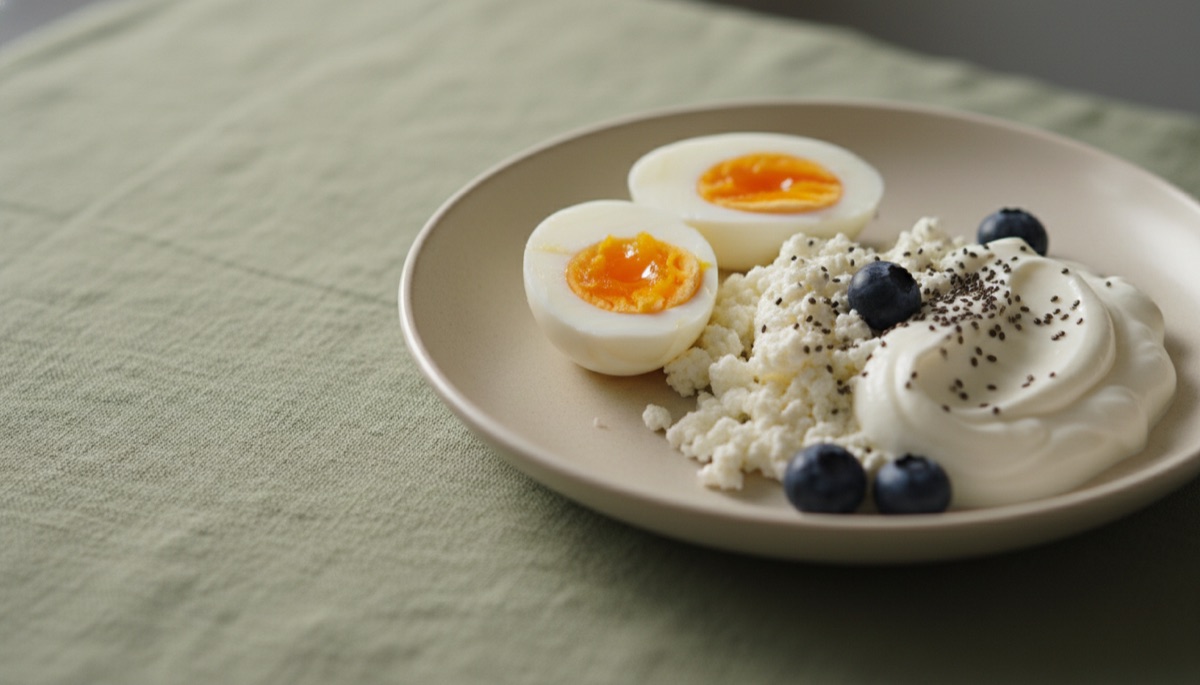
Front-load. A 20-30g protein breakfast when appetite is quietest. A protein-forward lunch (chicken, fish, tofu, Greek yogurt parfait). A shake as a bridge when dinner doesn't happen. Liquid protein (Greek yogurt, cottage cheese, whey shakes) tends to go down easier than whole cuts of meat on a slow-emptying stomach. Small protein additions to everything, a scoop of cottage cheese on a salad, a hard-boiled egg with crackers.
Does the body actually absorb that much at once?
The older '30g per meal ceiling' has been largely walked back. Recent research (Trommelen et al., Cell Reports Medicine 2023) suggests the muscle-protein-synthesis response scales up with doses well above 30g per meal, which is good news for GLP-1 users who often have 2 meals of 40-50g protein rather than 4 meals of 25g. The bigger driver is the daily total, not a per-meal ceiling.
Plant vs animal protein, does it matter?
The leucine content and complete amino acid profile matter more than the source. Animal proteins (whey, eggs, fish, meat) are naturally higher in leucine gram-for-gram. Plant proteins can match, but they generally require higher total intake (roughly 1.5x) and a blend of sources to cover the full amino acid profile. If you're plant-based, aim for the higher end of the 1.2-1.6g/kg range and mix sources (soy + pea + legumes + grains).
Should I take it all at one meal if that's all I can manage?
Better than not hitting the target at all, yes. But the muscle-protein-synthesis literature favors 2-4 feedings spread through the day over a single large dose, even when total intake is equal. If one meal is genuinely all you can do on a bad day, use a shake in the morning or evening to split it. Consistency over weeks matters more than perfection on any single day.
Can you have too much?
For healthy adults with normal kidney function, intakes up to 2g/kg/day are consistently safe in the research literature. For anyone with chronic kidney disease, higher protein intake is genuinely something to discuss with your nephrologist; the calculus there is different. For most GLP-1 users without kidney issues, undershooting is far more common than overshooting.
Does timing around my injection day matter?
Probably not. Nothing in the FDA prescribing information for Ozempic, Wegovy, Mounjaro, or Zepbound recommends specific food timing. What patients do notice: the day of the injection and the day after are often the lowest-appetite days of the week. Leaning on shakes, Greek yogurt, and soft proteins on those two days, with heavier whole-food meals later in the week, is a pattern that shows up in a lot of GLP-1 eating plans.
Sources
Related reading
The Complete GLP-1 Nutrition Guide: Protein, Muscle, and What to Eat
Protein targets, muscle preservation, electrolytes, micronutrients, and sample days of eating. The practical food companion for life on a GLP-1.
Best Protein Powders for GLP-1 Users
The protein powders that fit a 30g-per-scoop target, sit well on a slow-emptying stomach, and don't rely on artificial sweeteners readers don't want.